


When hunting for figures online or on flea-market apps, you'll sometimes spot items far below the going rate. "It's new but suspiciously cheap." "It ships from overseas — is it real?" "It looks clean in the photos, but I'm worried it isn't genuine." The more popular the character, the more you need to watch for fakes, bootlegs, and knockoffs.
Fake figures can be hard to judge from photos alone. It's important to decide by checking several points together — price, seller, product images, packaging, logo, JAN barcode, paint, sculpt, and accessories.
What you'll learn in this article
- What fake and bootleg figures are
- What to watch for in online stores, used shops, and flea-market apps
- How to check when you find a suspiciously cheap item
- How to read the packaging, logo, JAN code, and license marking
- What to look at in the paint, sculpt, base, and accessories
- A checklist you can use before buying
The Bottom Line: Judge a Fake by "Multiple Red Flags"
Fakes and bootlegs can be hard to identify reliably from a single point. A low price, a small scuff on the box, or overseas shipping can each occur with genuine items too.
What matters is looking at several red flags in combination. If a price far below market, unclear seller info, no photos of the actual item, no package image, and unclear return policy all pile up, it's safer to think carefully.
Makers also note, in effect, that examples of counterfeits don't necessarily apply to every fake. Treat identification not as an "absolute verdict" but as a way to lower your buying risk. Reference: Good Smile Company's guidance on counterfeits.
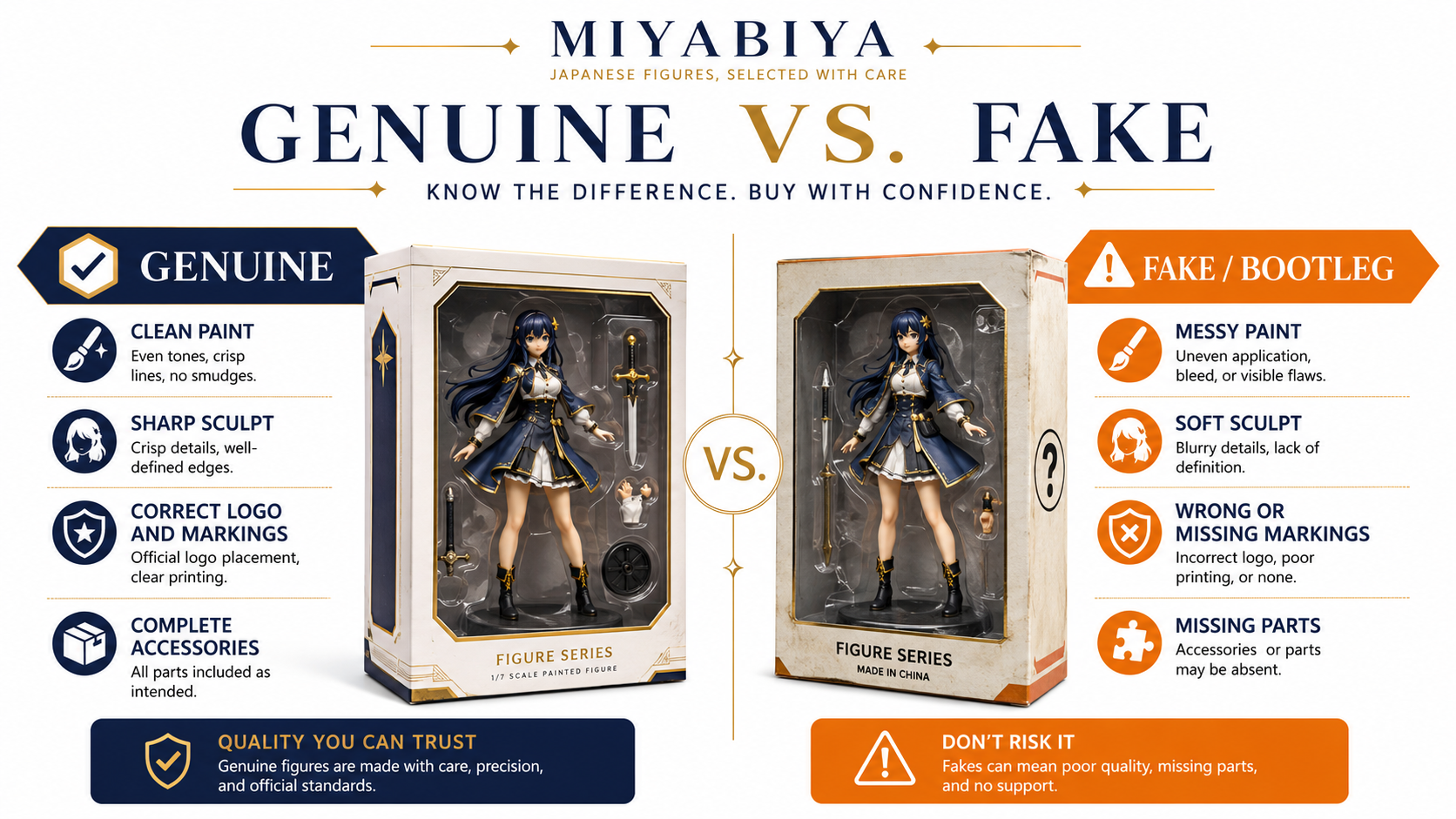
What Are Fake and Bootleg Figures?
Fake and bootleg figures are knockoffs made without permission from the legitimate rights holder or maker. They're sometimes sold using boxes and product images made to resemble the genuine item, which can be hard for beginners to tell apart.
Characteristics:
- Sculpt and paint quality can be low
- Parts may not fit
- The base or accessories may differ
- Text on the box or instructions can be unnatural
- You can't get official maker support
- Returns or exchanges can be difficult
Caution is also needed when buying from overseas. Customs provides guidance on cracking down at the border on goods that infringe trademark, design rights, and the like. Reference: Japan Customs, enforcement against intellectual-property-infringing goods.
What Is a Genuine Product? Knowing the Standard Comes First
A genuine product is one made under official license from the rights holder or maker and sold through legitimate distribution channels. To check whether something is genuine, it's important to compare against the official product page or information from a trustworthy seller.
Items to check:
- Maker name
- Brand name
- Product name
- JAN barcode
- Package markings
- License markings
- Logo
- Publisher / distributor
- Official product page
- Availability at official retailers
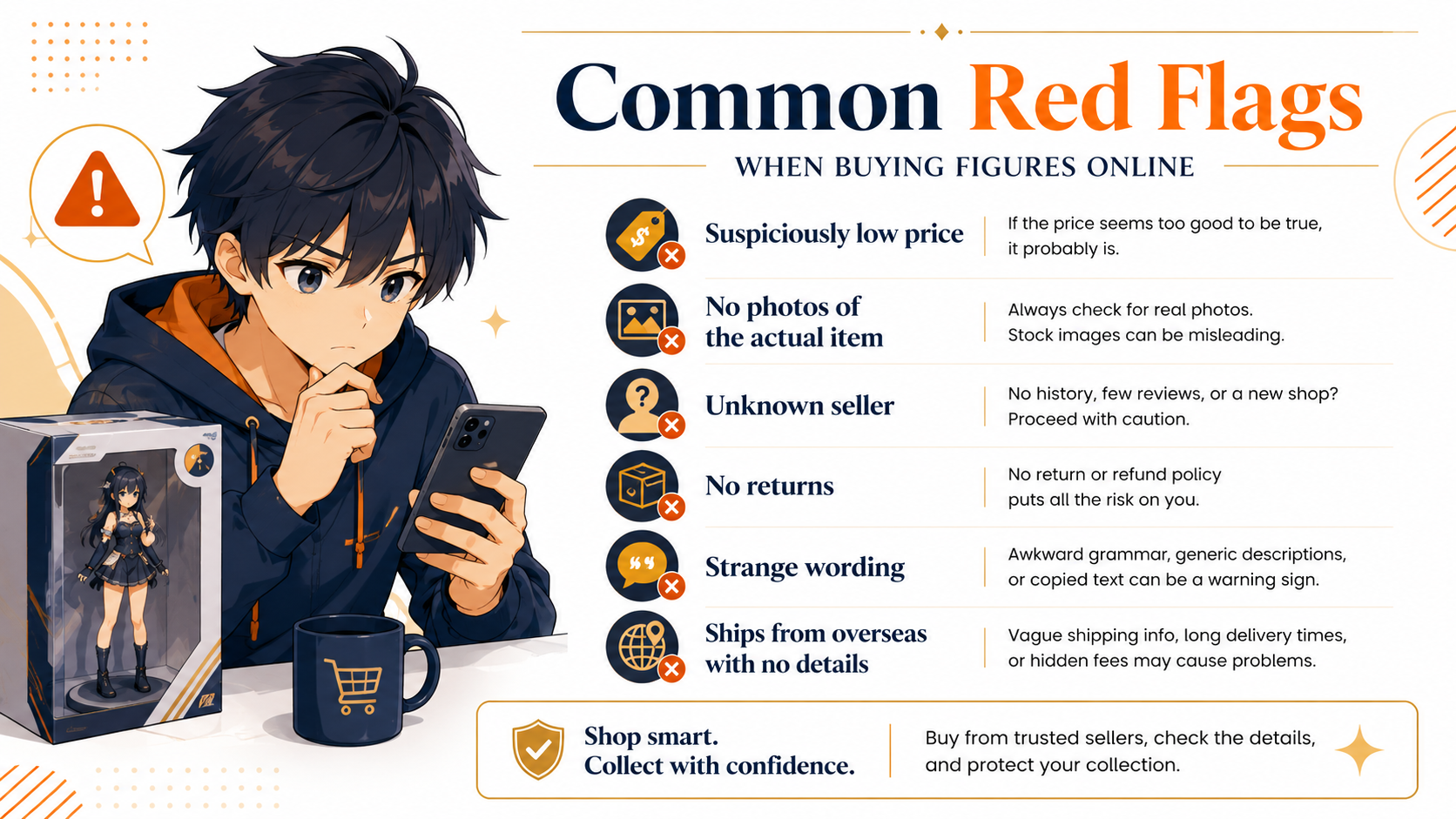
Be Wary First of "Suspiciously Cheap Figures"
The first thing to look at when avoiding fakes and bootlegs is the price. Japan's Consumer Affairs Agency, as part of fake-site countermeasures, advises checking whether the price is extremely low, whether contact details are shown, and whether the Japanese is unnatural. Reference: Consumer Affairs Agency, "Beware of fake sites."
Not every cheap item is fake. But when a popular figure is new and unopened yet far below market, it's safer to check the seller and product images carefully.
Possible reasons a price is low:
- Used item
- Opened
- Boxless
- Outer box damaged
- Missing accessories
- Stock clearance
- Overseas edition
- High shipping cost
- Poor condition
- Possible knockoff
- Possible fake site
CHECK 01: Verify the Seller and Shop Info
When buying a figure online, always check the seller. Even for the same item, safety varies by the shop or seller.
Items to check:
- Seller's name
- Address and contact
- Commercial-transaction-law disclosure
- Reviews and ratings
- Return and exchange terms
- Shipping origin
CHECK 02: Confirm the Images Are "Photos of the Actual Item"
Legitimate online stores sometimes use only official images, but on flea-market and used sales, items without photos of the actual product warrant caution. For expensive or worrying items, choosing ones with several photos of the actual item gives peace of mind.
Items to check:
- Box front and sides
- Barcode
- Close-up of the figure's face
- Base
- Accessories
- Outer-box damage
CHECK 03: Look at the Package Logo, Markings, and JAN Code
The packaging is also important when verifying authenticity. Check the maker name, brand logo, JAN barcode, license markings, rough printing, and any oddness in the Japanese text.
Items to check:
- Maker name
- Brand logo
- JAN barcode
- Barcode
- License markings
- Print quality
CHECK 04: Don't Judge by the License or Authorization Sticker Alone
License and authorization stickers are clues to authenticity, but judging by them alone is risky. Whether a sticker is present can vary by item and distribution route, and fakers may imitate genuine-looking markings.
Items to check:
- Presence of a sticker
- Position
- Print quality
- Difference from official images
- Seller
- Price
CHECK 05: Look at the Description's Japanese and Amount of Detail
Suspicious sales pages can show red flags such as a vague product name, no maker name, no return terms, or extremely unnatural Japanese.
Items to check:
- Official product name
- Maker name
- Size and material
- Return terms
- Shipping origin
- Naturalness of the Japanese
CHECK 06: Check the Sculpt of the Face, Eyes, and Hair
When looking at the figure itself, check the face first. The sculpt of the face, eyes, and hair is what defines the character's impression. When comparing with official images, it's best to look at multiple images — front, angled, and side.
Items to check:
- Facial balance
- Eye printing
- Position of the mouth and nose
- Tips of the hair
- Expression
- Skin tone of the face
CHECK 07: Look at Paint Bleed, Color, and Gloss
Even genuine items have individual variation, but if the paint is extremely sloppy, the color differs greatly from official images, or the color separation on decorations is unnatural, look at the other check items together.
Items to check:
- Paint bleed
- Skin tone
- Outfit lines
- Hair color
- Gloss
- Detailed color separation
CHECK 08: Look at the Base, Accessories, and Swap Parts
Even when not fake, used and flea-market items can have missing accessories. If it says "what you see in the photo is everything," compare against the official accessories.
Items to check:
- Base
- Support
- Face plates
- Hand parts
- Weapons
- Effects
- Instructions
CHECK 09: Look at Reviews, Ratings, and Sales History
On online stores and flea-market apps, the seller's reviews and ratings matter too. A high rating doesn't guarantee absolute safety, but check carefully if a seller has too few ratings or is listing many of the same popular figure cheaply.
Items to check:
- Number of ratings
- Content of negative ratings
- Sales track record
- Bulk listings
- Shipping problems
- Return handling
CHECK 10: Be Especially Careful with Overseas Shipping and Personal Imports
Not every overseas-shipped item is dangerous — there are legitimate overseas shops and genuine imports. However, always check the seller, whether it's an official retailer, shipping cost, customs duties, return handling, and delivery time.
Items to check:
- Seller
- Official retailer status
- Shipping origin
- Shipping and customs costs
- Return handling
- Delivery time
Check Points by Channel: Online, Used, and Flea-Market
Checkpoints to Avoid Fakes Online
- Is the seller clear?
- Is there a commercial-transaction-law disclosure?
- Is the price not far off the market rate?
- Do the product images look natural?
- Is there a package image?
- Are there return and exchange terms?
- Is the shipping date clear?
- Is there anything unnatural in the reviews?
Regarding fake shopping sites, Japan's National Police Agency describes tactics such as not shipping the product or shipping a fake. If you suspect you've been harmed, you should also check the consultation contacts. Reference: National Police Agency, measures against fake shopping and fraud sites.
Checkpoints to Avoid Fakes in Used Figures
- Is the product name the official name?
- Is the maker name correct?
- Is there an outer box?
- Is there a JAN code or barcode?
- Are the accessories complete?
- Are the photos of the actual item?
- Are the condition notes specific?
- Is the price not far off the market rate?
Checkpoints to Avoid Fakes on Flea-Market Apps
- Are there several photos of the actual item?
- Is there a photo of the box?
- Are the barcode and maker markings visible?
- Are there photos of the accessories?
- Is the seller's rating fine?
- Are they not listing many of the same item in bulk?
- Do they answer questions about unclear points?
The Difference Between "Domestic Genuine," "Overseas Genuine," and "Imports"
Domestic Genuine
Often refers to items sold through legitimate distribution within Japan. They may carry domestic-market packaging or a domestic distributor's markings.
Overseas Genuine
Can refer to items legitimately distributed for overseas markets. Overseas editions can be genuine too, but the packaging and stickers may differ from the domestic edition.
Imports / Parallel Imports
Refers to items imported from overseas. They can be genuine, but you need to check the seller, condition, and return handling. Don't assume "import = fake" — look at the amount of detail and the seller.
What to Do When You Think "This Might Be a Fake"
If you feel "this might be fake" before buying, the safest thing is not to force the purchase. If doubt remains, the decision to pass is important too.
How to respond:
- Compare with the official product page
- Check the seller's information
- Look up the market price
- Request photos of the actual item
- Check the JAN code and package photos
- Look at reviews and ratings
- Compare other sales pages too
- Don't buy if doubt remains
What to Do If You May Have Bought a Fake
If, after buying, you feel "this might be fake," first preserve the evidence — save the product photos, the sales page, your order history, payment records, messages with the seller, and the shipping slip.
Then consult the seller, the platform, or your payment company. If you're stuck with a consumer problem, the Consumer Affairs Agency's Consumer Hotline 188 is also a place to check. Reference: Consumer Affairs Agency, Consumer Hotline. If a fake site or fraud site is suspected, also consider the police station or a cybercrime consultation desk.
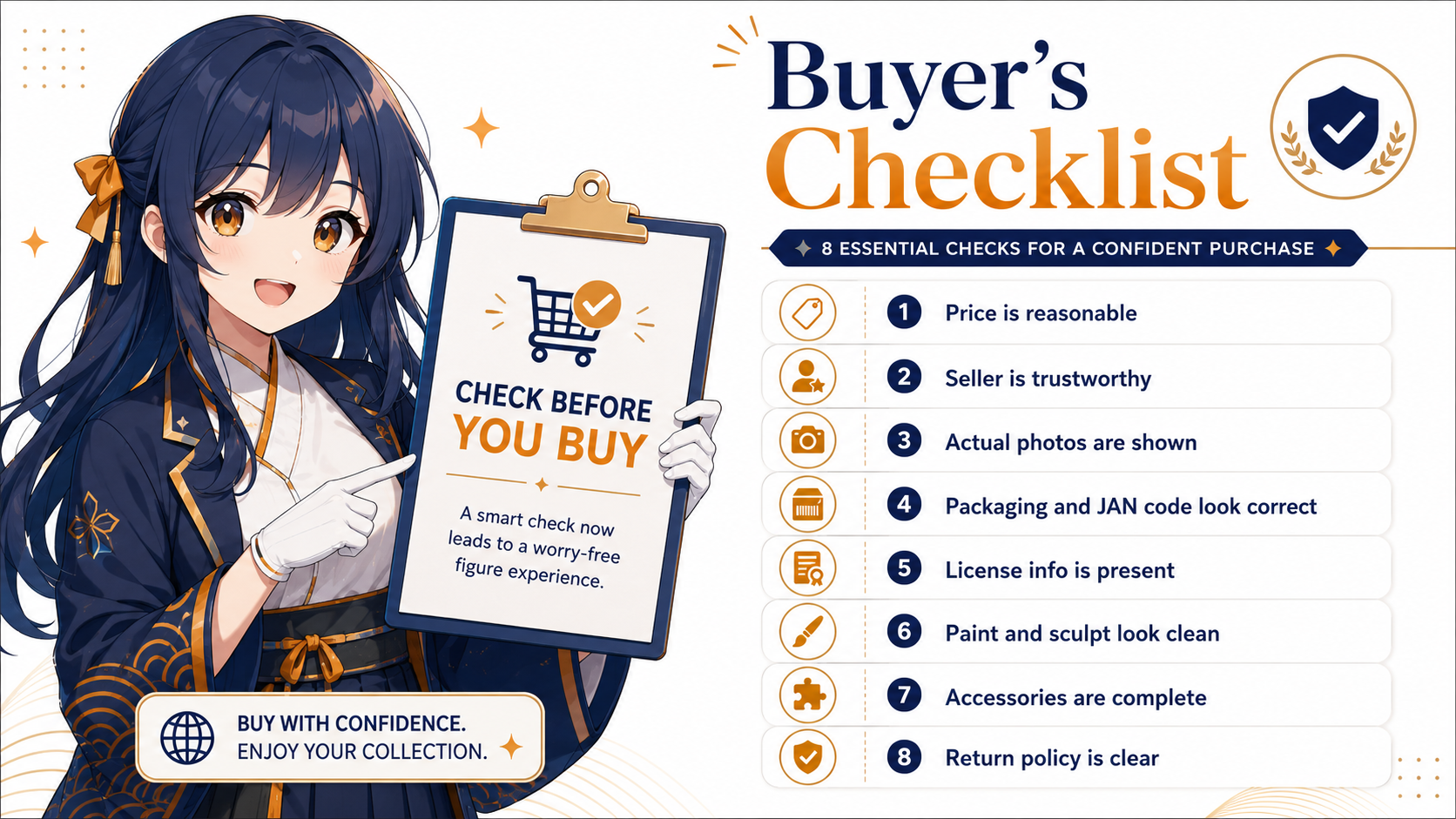
A Pre-Purchase Checklist to Avoid Fakes and Bootlegs
- Is the price not extremely far below market?
- Is the seller's information clear?
- Is there a commercial-transaction-law disclosure?
- Is the product name the official name?
- Is the maker name listed?
- Is there a package photo?
- Can you verify the JAN code / barcode?
- Is there no big difference from the official product page?
- Are there photos of the actual item?
- Is there nothing odd about the face, eye, and hair sculpt?
- Is the paint not extremely sloppy?
- Are the base and accessories correct?
- Are return and exchange terms clearly stated?
- Is there no problem with the seller's or shop's rating?
- Can you decide to pass if doubt remains?
FAQ
Where should I look to tell if a figure is fake?
Look at the price, seller, product images, packaging, JAN code, logo, paint, sculpt, base, and accessories together. Don't judge by a single point — check whether several red flags appear.
If there's a license sticker, is it genuine?
A license sticker is a useful clue, but concluding it's genuine from that alone is risky. Sticker presence can vary by item and distribution route, so verify alongside the seller and official info.
Are overseas-edition figures fake?
Not all overseas editions and imports are fake — there are genuine overseas products too. Just check the seller, price, packaging, and return handling carefully.
Should I avoid figures cheaper than market?
Not all cheap items are fake. But if it's far below market, check whether there's a reason such as used, missing parts, box damage, an overseas edition, a knockoff, or a fake site.
How do I verify authenticity on a flea-market app?
Check the photos of the actual item, the box, the JAN code, maker markings, accessories, and the seller's rating. If needed, it's best to request extra photos before buying.
What should I do if I bought a fake?
Save the product photos, sales page, order history, payment records, and messages with the seller, then consult the seller or payment service. For consumer trouble, consider the Consumer Hotline 188; for fake-site harm, consider the police or a cybercrime consultation desk.
Summary: To Choose Genuine, Look at "Seller, Photos, and Detail" Over "Cheapness"
To avoid fake and bootleg figures, it's important not to judge by price alone. Check whether the seller is trustworthy, whether the price isn't extremely below market, whether there's a package photo, whether you can verify the JAN code and maker name, and whether the return and exchange terms are clear.
Completely identifying a fake isn't easy. That's exactly why it's important to check multiple pieces of information — and to be willing to pass on the purchase when doubt remains.
Reference Information
Official and Public Information
- Good Smile Company: guidance on counterfeits
- Japan Customs: enforcement against intellectual-property-infringing goods
- Consumer Affairs Agency: "Beware of fake sites"
Where to Get Help
- Consumer Affairs Agency: Consumer Hotline
- National Police Agency: measures against fake shopping and fraud sites
