


"My figure box is bulky and gets in the way." "Is it OK to throw the box away?" "Does tossing the box lower the value?" These are common worries for figure collectors. You display the figure itself, but the outer box and blister tray take up a lot of space.
The short answer: figure boxes are not something you absolutely must keep. That said, for figures you might sell in the future, expensive scale figures, and items with lots of accessories such as Nendoroids and figmas, keeping the box is the safer choice.
The Bottom Line: When in Doubt, Keep the Box
What a figure box does for you:
- Helps the figure hold its value when you resell
- Keeps accessories together and easy to store
- Protects the figure from damage during a move
- The blister tray lets you store the figure safely
- Serves as proof that the item is genuine
- Makes the collection feel more complete
Keep the box if you might sell it, want to preserve its value, or it's an expensive item. It's fine to toss it if you only plan to display it, don't care about the box, and want to prioritize storage space.
What Counts as a "Figure Box"? Outer Box, Blister, and Accessories
| Part | Role |
|---|---|
| Outer box | The package showing the product name, maker, character name, and photos |
| Blister tray | The clear case inside that holds the figure and parts in place |
| Backing / inner box | Paper parts used for the background or to hold things in place |
| Instructions | Paper with assembly steps and cautions |
| Accessory bag | Bag holding swap parts and small items |
| Base / support | Parts needed to display the figure |
The reason many people feel "the box is in the way" is that it's not just the outer box but the blister tray that takes up room. The outer box can sometimes be flattened, but the blister is molded to the figure's shape, so it generally has to be stored at full size.
The Benefits of Keeping a Figure Box
It Helps When You Sell Later
The biggest reason to keep a figure box is that it tends to help when you sell. With used figures, buyers check not only the condition of the figure but also whether the outer box, blister, instructions, and accessories are present. Appraisal standards vary by shop and item, but in general a figure that is complete with box, accessories, and in good condition is more likely to be chosen.
You're Less Likely to Lose Accessories
- Nendoroids: face plates, hands, arms, legs, small items, base, support
- figma and other articulated figures: swap hands, weapons, face parts, joints, stand
Keeping the box and blister makes these easier to manage in one place. Even if you don't plan to sell, losing parts limits how you can display or pose the figure, so the box is handy for accessory management too.
It Prevents Damage During a Move
Figures are delicate around the hair, fingertips, weapons, wings, ribbons, and effect parts. With the box and blister, you can secure the figure and its parts close to their original positions, making damage during a move less likely.
Figures whose boxes are worth keeping:
- Scale figures
- Expensive figures
- Figures with clear effect parts
- Figures with large, spread-out hair or outfits
- Figures with long, thin parts like weapons or staffs
- Figures assembled from multiple parts
It Serves as Proof of Authenticity
The outer box often lists the maker name, brand logo, copyright notice, product name, JAN barcode, and cautions. When buying or selling used, having the box makes it easier for the buyer to verify the item.
It Adds to Collector Satisfaction
A figure box isn't just packaging — it can be enjoyed as part of the collection. Boxes carry character art, product logos, series names, and maker info. Displaying figures with their boxes, storing the boxes on a separate shelf, or simply admiring the box design — everyone enjoys it their own way.
The Downsides of Throwing the Box Away
Resale Value Tends to Drop
The biggest downside of tossing the box is that resale value tends to fall. This matters especially for scale figures, Nendoroids, figmas, limited editions, and bonus-item products, where the presence of the box, blister, and accessories is important. Boxless figures can still sell, but compared with boxed ones, the sense of reassurance and collectibility for the buyer tends to be lower.
You're More Likely to Lose Accessories
Once the box is gone, you have to manage accessories separately. Small hand parts, face parts, weapons, effects, supports, and base joints are easy to lose, and once lost they can be hard to find individually. Even if you toss the box, always store the accessories sorted into small bags.
Moving and Shipping Become Harder
Boxless figures are harder to pack for moving or shipping. With the original box and blister you can store the figure and parts safely, but without the box you'll need to pack it yourself using cushioning, zip bags, and cardboard.
It's Treated as a "Boxless" Item
If you throw the box away, a future sale will generally be handled as a boxless figure. Even if the figure itself is clean, some buyers rule it out simply because there's no box. Collectors in particular often value "with box," "with blister," and "complete with accessories," so boxless tends to be at a disadvantage.
People Who Can Throw the Box Away
People Who Only Display Their Figures
If you have no plans to sell and just enjoy displaying figures, throwing the box away may be fine. If keeping boxes is crowding your living space, you don't have to force yourself to keep everything. That said, don't throw away the base, support, swap parts, or instructions.
People Who Casually Collect Prize Figures
Prize figures are a genre many people collect casually for display. Depending on the item, many have fewer accessories than scale or articulated figures, so they can be easy to display even without the box.
People Whose Living Space Is Crowded by Boxes
Figure boxes become a real storage problem as your collection grows. If your room is getting cramped, your closet is unusable, or it's becoming a daily stress, reducing the number of boxes is a realistic choice.
People Who Should Not Throw the Box Away
- People who might sell in the future
- People who collect scale figures
- People who own accessory-heavy items like Nendoroids and figmas
- People who own limited editions or bonus-item products
Even if you don't intend to sell now, the time to sell can come through collection cleanup, a move, lack of storage, or a change in the series you're into. When that happens, whether you have the box can change how easily it's chosen and the impression at appraisal.
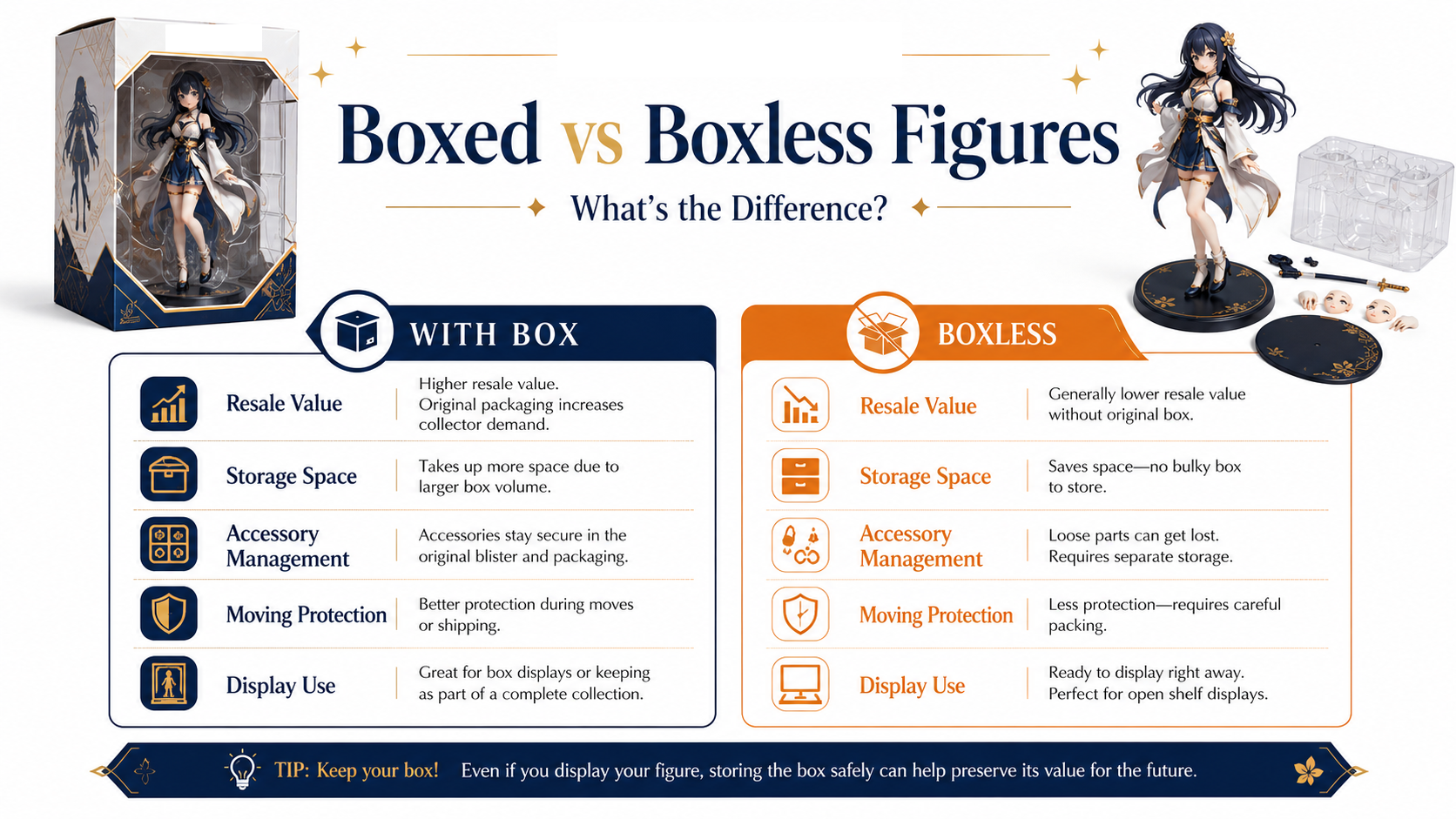
The Difference Between "With Box," "Boxless," and "Damaged Box"
| Condition | Characteristics | Best for |
|---|---|---|
| With box, mint | High collectibility; advantageous for storage and resale | People who want to preserve value |
| With box, box damaged | The box is worn but still offers more info and protection than boxless | People who want to keep it even if not perfect |
| Boxless, with accessories | Plenty enjoyable if your goal is display | People who prioritize price and space |
| Boxless, missing parts | Sometimes cheaper, but affects display and value | People who understand what's missing |
| Figure only | The base or support may be missing | Advanced collectors |
The key point: even a damaged box can be more useful than no box. If it's only slightly dented, has worn corners, or some scuffing, it's still worth keeping rather than tossing.
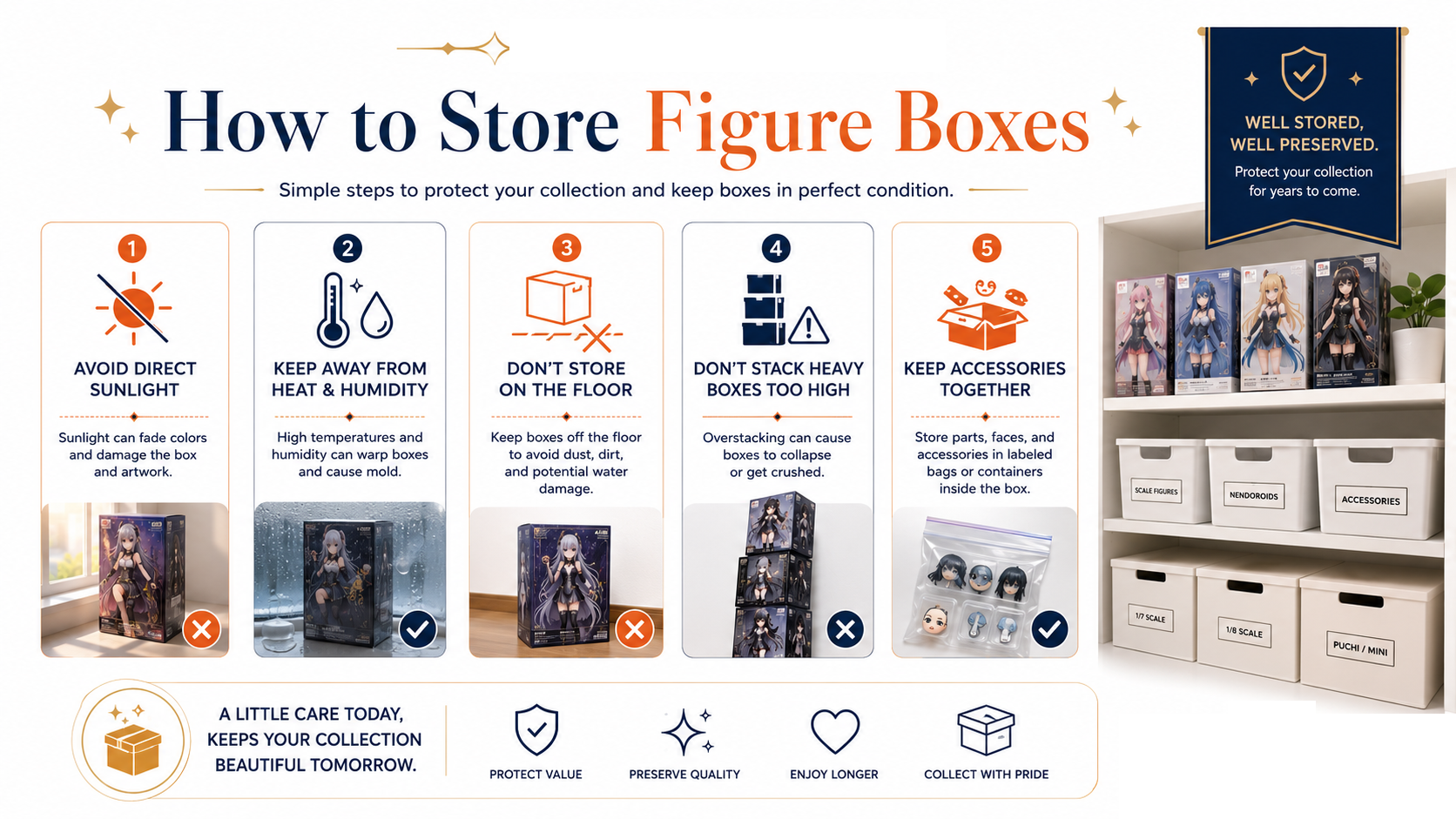
How to Store Figure Boxes
Avoid Direct Sunlight
Outer boxes are usually paper, so direct sunlight easily causes fading and discoloration. A closet, cupboard, or storage shelf where light doesn't reach is ideal.
Avoid Heat and Humidity
Boxes are vulnerable to moisture. Stored in a humid place, a box can warp or develop a musty smell. Both the box and the figure itself are sensitive to heat and humidity, so be careful where you store them.
Don't Place Boxes Directly on the Floor
Placing boxes straight on the floor exposes them to moisture and dust. Use a storage rack, shelf, or plastic case to keep them slightly off the floor.
Don't Stack Heavy Boxes Too High
Stacking heavy boxes on top can crush the boxes underneath or deform the blister. As a rule, put large scale-figure boxes on the bottom and small, light boxes on top.
How to Sort Things Out When You Have Too Many Boxes
Boxes to Keep First
- Expensive scale figures
- Limited editions
- Bonus-item products
- Nendoroids
- Articulated figures with many accessories, like figmas
- Items you might sell in the future
- Items whose box design you also like
Boxes You Won't Regret Tossing
- Figures you have no plans to sell
- Relatively inexpensive prize figures
- Boxes that are badly damaged
- Fixed-pose items with few accessories
- Items you're happy with as the figure alone
Before tossing, always check that no instructions, supports, swap parts, small items, or base parts remain inside.
Is It OK to Just Flatten the Box?
For some items, the outer box alone can be flattened for storage. The benefit of flattening the outer box is saving storage space. The trade-off is that you can't keep the blister, so protection during transport is reduced.
Recommended approach:
- Open it carefully so it doesn't tear
- Keep the side that shows the product name
- Manage instructions and accessories separately
- Store the flattened boxes together in a file or storage case
- Decide separately whether to keep or toss the blister
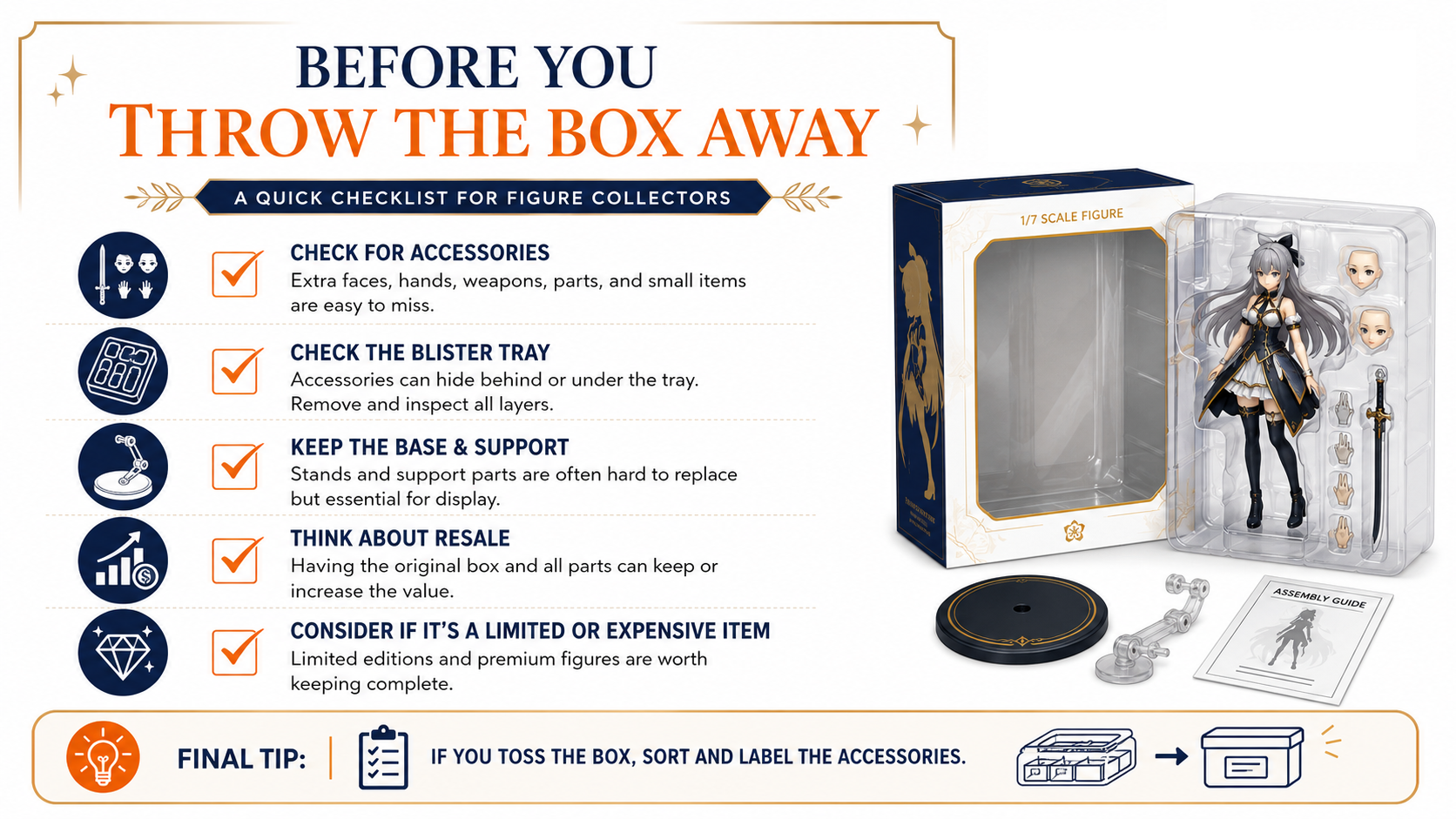
A Must-Check List Before Throwing the Box Away
| Check item | Why it matters |
|---|---|
| Any accessories left inside the box? | So you don't toss small items, hands, or instructions |
| Any small parts left in the blister? | Clear parts are easy to overlook |
| Did you take out the base and support? | They may be needed for display |
| Did you keep the instructions? | Useful for assembly and resale |
| Any chance you'll sell it later? | Value may drop without the box |
| Is it a limited or expensive item? | The box may be especially important |
| Did you note the product name and model number? | Makes it easier to search later |
| Did you sort the accessories? | To prevent loss |
By Type: How to Decide on Throwing the Box Away
Prize Figure Boxes
If you only display them, you're less likely to regret tossing the box. That said, for popular characters, boxes in good condition, or if you plan to sell several together later, keeping them is fine.
Nendoroid Boxes
Because they come with many accessories like face plates and hand parts, keeping the box is recommended. If you do toss it, put the accessories in small bags and label them with the product name.
figma and Articulated Figure Boxes
With many swap hands, weapons, faces, supports, and joints, management becomes hard without the box. Even if you toss the box, parts management is essential.
Scale Figure Boxes
Scale figures tend to be expensive, and many have delicate hair, outfits, bases, and effects. As a rule, keeping the box is recommended.
How to Store Without Regret After Tossing the Box
If you're going to toss the box, always sort the accessories. Put them in zip bags or small parts cases and note the figure name, character name, maker, the accessory contents, and whether the base and support are included. It also helps to photograph the box front, sides, product name, maker, JAN barcode, accessory list, the layout inside the blister, and the instructions, so you can check details later.
It Doesn't Have to Be "Keep Everything" or "Toss Everything"
The important thing about box storage is not to aim for perfection. Trying to keep everything leaves you short on space; tossing everything causes trouble at resale or when moving.
| Category | Decision |
|---|---|
| Always keep | Expensive items, limited editions, accessory-heavy items |
| Keep if unsure | Items you might sell in the future |
| OK to toss | Inexpensive display-only items, items with badly damaged boxes |
How to Shop for Boxed and Boxless Figures at MIYABIYA
A figure box helps with storage, resale, and accessory management. If you might sell in the future or you value collectibility, choosing a boxed figure gives peace of mind. On the other hand, if your goal is simply to display and enjoy, a boxless figure can be a great-value option. What matters is checking not just whether there's a box, but the balance of figure condition, accessories, base, and price.
- Browse used figures
- Browse boxed figures
- Browse boxless figures
- How to choose used figures
- The difference between prize and scale figures
- How to spot fake and bootleg figures
Summary: When in Doubt, Keep It — If You Toss It, Manage the Accessories
A figure box is not something you absolutely must keep. But if you're unsure, keeping it leaves you less likely to regret it.
- Helps when you sell
- Makes accessories harder to lose
- Prevents damage during a move
- Serves as proof of authenticity
- Adds to collector satisfaction
If you toss the box, always check that no base, support, instructions, swap parts, or small items remain. Keep the box if you want to preserve value; boxless is fine if you prioritize display. Decide in a way you won't regret, based on how you enjoy your figures.
FAQ
Is it OK to throw away a figure box?
If you only display it yourself, throwing the box away is fine. However, if you might sell in the future, or for expensive figures, limited editions, and figures with many accessories, keeping the box is safer.
Does throwing away the box lower the value?
Generally, going boxless tends to lower the value. With used figures, not only the figure's condition but also the presence of the box, blister, instructions, and accessories can affect the appraisal.
Can I still sell a boxless figure?
Boxless figures can still sell. However, appraisals and selling prices tend to be lower than with a box, and missing or damaged accessories make it even less favorable.
Should I keep the box even if it's damaged?
For light dents or scuffs, keeping it can be more useful than going boxless. That said, watch out for boxes with mold or a strong odor, as they can affect the figure too.
Is it OK to throw away the blister tray?
The blister is an important part that holds the figure and accessories in place. Especially for scale figures and items with many delicate parts, it helps with moving and storage.
Is it OK to throw away a prize figure box?
If your goal is just display, tossing a prize figure box is often fine. But if you plan to sell several together later, or want to keep the box design too, keeping it gives peace of mind.
Is it OK to throw away a Nendoroid box?
Nendoroids come with many accessories like face plates and hand parts, so keeping the box is recommended. If you toss it, put the accessories in small bags and label them with the product name.
Should I keep a scale figure box?
A scale figure box is generally worth keeping. These tend to be expensive, and many have delicate hair, outfits, bases, and effects, so a box with a blister helps when moving or selling.
Where's the best place to store figure boxes?
Somewhere out of direct sunlight and not prone to heat or humidity is ideal. Keep them in a closet or storage shelf, off the floor, and don't stack heavy boxes too high.
What should I check before throwing the box away?
Check that no accessories, instructions, base, support, swap parts, or small items remain in the box. Small parts can sometimes hide in the gaps of the blister.
Can I flatten the box for storage?
For the outer box alone, flattening for storage is possible in some cases. However, tossing the blister reduces protection during transport. Manage accessories separately and keep the product and maker name visible.
Is buying a boxless figure a bad deal?
If your goal is display, a boxless figure can be a great-value choice. Still, it's important to check the accessories, base, figure condition, any damage, and the risk of fakes.
